
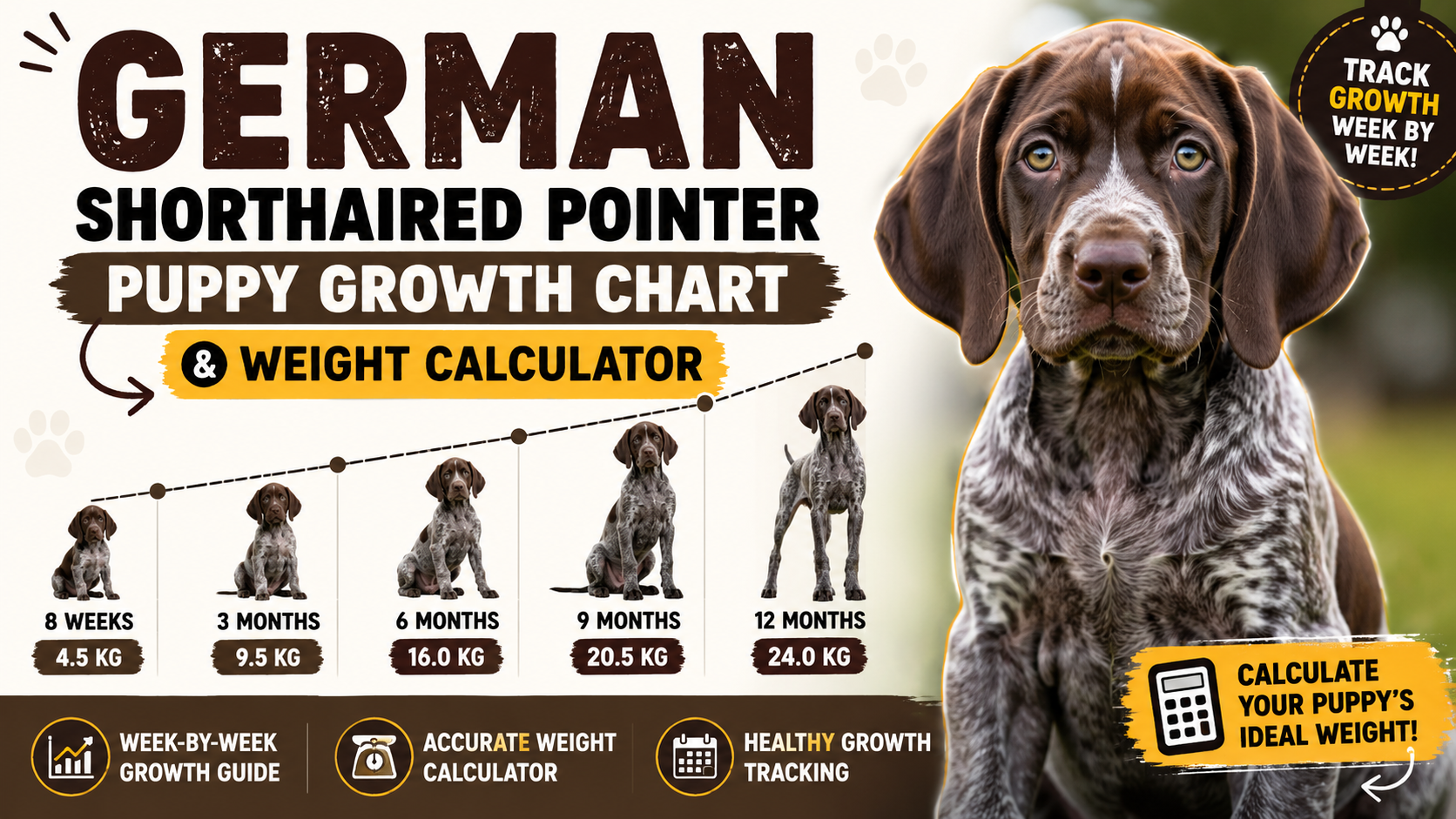
German Shorthaired Pointer Growth & Weight Calculator
Track your sporting puppy’s development milestones and estimate their final adult weight.
GSP Standard Benchmark Ranges
| Age Milestone | Male Weight Range | Female Weight Range |
|---|---|---|
| 2 Months | 15 – 20 lbs (6.8 – 9.1 kg) | 13 – 18 lbs (5.9 – 8.2 kg) |
| 4 Months | 30 – 40 lbs (13.6 – 18.1 kg) | 27 – 37 lbs (12.2 – 16.8 kg) |
| 6 Months | 45 – 55 lbs (20.4 – 24.9 kg) | 40 – 50 lbs (18.1 – 22.7 kg) |
| 9 Months | 50 – 65 lbs (22.7 – 29.5 kg) | 48 – 55 lbs (21.8 – 24.9 kg) |
| 12 Months | 55 – 70 lbs (24.9 – 31.8 kg) | 50 – 60 lbs (22.7 – 27.2 kg) |
| Adult (18+ Mo) | 55 – 70+ lbs (24.9 – 31.8+ kg) | 45 – 60 lbs (20.4 – 27.2 kg) |
As a breeder, tracking German Shorthaired Pointer growth involves analyzing more than a standard chart. Each puppy exhibits unique development across early months. Monitoring weight and age helps ensure these athletic, lean hunting dogs thrive.
Utilizing an online calculator provides a helpful estimate for future adult size, though genetic factors disrupt any rigid formula. During rapid developmental phases, proper nutrition and fine diet choices support their highly energetic, independent personalities.
Table of Contents
Male German Shorthaired Pointer Growth Chart
Observing male canine milestones reveals unexpected trajectories. A sturdy German Shorthaired Pointer expands rapidly, recording massive lbs metrics. Active dogs demand structured overwatch because their frame development requires careful, balanced, specific exercise routines every week.
Predicting final adult size involves checking ancestry. Our comprehensive growth chart assists owners, but deep genetics and premium nutrition ultimately dictate your companion’s true height. Regular veterinary visits ensure this active breed matures safely everyday.
Female German Shorthaired Pointer Growth Chart
Evaluating a female canine progress requires noting distinct shifts. Bony framework finishes extending around twenty inches. Breeder records show structural expansion stabilizes before hefty flesh bulk fills her streamlined frame between 45 plus 60 pounds.
Hormonal changes cause females to mature more slowly than owners anticipate. Analyzing metabolic shifts rather than raw size provides better clarity. Schedule veterinary check ups to confirm your companion maintains a healthy growth rate continuously.
German Shorthaired Pointer Weight
Predicting canine mass involves tracking how GSPs evolve over time. As an experienced handler, I notice their weight fluctuates before they reach the breed standard. Continuously monitoring this development ensures these active companions stay healthy.
Every dynamic puppy follows a unique lifestyle trajectory. Evaluating structural muscle mass helps determine if your dog matures at a healthy rate, avoiding potential long-term health concerns associated with improper nutrition or sudden growth spurts.
German Shorthaired Pointer Size & Breed Overview
Observing these versatile canine athletes reveals remarkable physical capabilities. Their boundless energy suits active families or traditional hunters perfectly. Typically, Pointers occupy a solid medium to large structural range, showcasing incredible, keen intelligence every day.
Analyzing dimensions, mature males reach a prominent shoulder height, frequently measuring 23 to 25 inches tall. Conversely, lighter females scale down, averaging between 45 and 60 pounds while remaining beautifully balanced and highly agile companions.
Neonatal Stage (0 – 2 Weeks)
Observing these blind canine newborns right after birth reveals complete maternal dependence. This initial 0 to 2 weeks stage demands minimal external handling, as frail GSP puppies merely nurse, sleep, and struggle with regulating temperature.
Dedicated breeders prioritize daily weight tracking over complex nutrition regimens now. Survival during this fragile phase hinges on maternal care, ensuring every helpless whelp receives rich colostrum, keeping them healthy before subsequent growth steps unfold.
Transitional Stage (2 – 4 Weeks)
Canine eyes open during this brief phase, revealing a shifting sensory world. Observation shows puppies testing coordinated steps, escaping early structural limits. Rapidly developing nervous systems transform basic instincts while initial weight gains establish health.
Practitioners note emergence of audible vocalizations as littermates process environmental sounds. This milestone stage spans critical weeks where auditory awareness sparks cognitive exploration, prompting subtle interactive behaviors that redefine early canine learning dynamics within nests.
Socialization Stage (4 – 12 Weeks)
In my years breeding, this psychological window shapes everything. Young puppies possess highly flexible neural pathways now. True socialization is not about fun; it prevents deep fear responses later. Watch how they become intensely curious.
We must purposefully expose them to distinct novel textures and sounds. When they safely interact with varied complex surroundings, their baseline confidence skyrockets. Early defensive conditioning during this phase always requires careful, intentional training frameworks.
Juvenile Stage (3 – 6 Months)
Experiencing this puppy phase reveals sudden gangly leg extensions. Your GSP undergoes massive structural changes here, meaning metabolic tracking over these months requires vigilant monitoring. Adjust their premium food intake to support an optimal rate.
Proactive pet ownership means recognizing structural growth vulnerabilities very early on. While tracking current weight patterns, ensure their high quality diet prevents skeletal stress. A healthy foundation prevents joint issues before full physical maturity arrives.
Adolescent Stage (6 – 18 Months)
Managing a versatile gun dog during this phase requires patience. Between 12 to 18 months, their unique muscle mass develops rapidly. Avoid forced running or intense hunting trials until their fragile structural frame finishes stabilizing.
Youngsters often look taller or uncoordinated if kept intact because vital sex hormones guide growth plates. Watch them slowly fill out naturally without introducing strenuous jumping exercises; they eventually become superb sporting companions for life.
Adult Stage (2 Years and Beyond)
Reaching 2 years marks full maturity. These Pointers transition from rapid development into stable maintenance. As a seasoned trainer, I observe that managing their health relies strictly on tracking daily activity rather than generic charts.
Their energy level stabilizes now, demanding deeply focused work. Maintain regular and intense field conditioning to protect active muscles. Through direct experience, field performance mirrors behavioral maturity, proving that adulthood locks in working behavior permanently.
When Do German Shorthaired Pointers Stop Growing?
Skeletal maturity occurs long after initial height plateaus. My clinical observation confirms GSPs push spatial boundaries past expectation. They look adult, yet internal plates solidify around 2 separate phases, defying the flat standard growth predictions.
Psychological stability lags behind structural frames. Canines often remain stubborn on hard training days before they fully stabilize. Expecting quick finishes always ignores how substantial structures fill out until they are emotionally mature field companions.
Genetics
In my years breeding, observing hereditary blueprints directly reveals how a puppy’s athletic capacity unfolds. DNA dictates the unique skeletal foundation, mapping out an intelligent companion whose ultimate physical build depends heavily upon lineage markers.
Confronting ancestral health conditions daily requires analyzing parental sizes before calculating puppy growth. DNA programs internal stamina and endurance, meaning field lines mature differently than show structures, a reality making standardized canine metrics deeply unpredictable.
Nutrition
Managing canine development requires understanding skeletal milestones. Excessive calcium or phosphorus acceleration causes structural problems, as rapid maturation strains joints. Avoid overfeeding to protect performance stamina; always provide constant access to fresh, clean, water nearby.
Experienced handlers realize premium fuel optimizes growth. Prioritize chicken, beef, or fish as the main ingredient, ensuring a dense protein source anchors systemic development. Distribute total targeted food portions into distinct, specific meals per day.
Exercise
Managing a young pointer demands counterintuitive physical restraint. Overworking developing bones and fragile joints risks severe lifelong structural damage. Instead of forced endurance runs, focus on brief sessions tailored strictly to their current biological maturity.
A standard guideline prescribes 5 minutes per month of age, vigorously offered twice daily. For example, a 4 month old requires 20 minutes twice, protecting canine health while efficiently burning off hyperactive puppy growth energy.
Health
Managing active GSPs requires monitoring severe skeletal changes. Rapidly developing skeletal frame systems often hide hidden indicators of developmental pain. Consequently, juvenile structural bones and unstable joints face chronic breakdown, magnifying every athletic structural risk.
Anatomical depth introduces acute internal dangers. Sudden bloat occurs when an expanded canine stomach tragically fills with trapped gas and instantly twists. This remains a serious, terrifying reality that demands immediate clinical veterinary crisis intervention.
Spaying/Neutering
Altering canine physiology alters joint development timeline mechanics fundamentally. When a gundog is neutered prematurely, tibial plateau angles shift because growth plates delay closure. Seeking expert clinical advice helps mitigate these severe orthopedic risks effectively.
Hormonal depletion impacts metabolic baselines, causing rapid fat accumulation if caloric intake remains unadjusted. Your trusted veterinarian must evaluate the growing breed skeleton before performing a pediatric spay surgery to ensure optimal future structural integrity.
German Shorthaired Pointer Ideal Weight & Body Condition
Evaluating a medium canine requires observing physical structural feedback directly. Manual palpation reveals true body fitness, bypassing misleading scale numbers entirely. Preventing insidious overfeeding safeguards their inherently active frames, ensuring an ideal performance condition always.
Proactively detecting subtle structural shifts prevents future joint degradation later. By addressing these hidden issues early, handlers shield developing frames from chronic stress. Prioritizing lean mass over rapid weight gain protects sensitive joints during activities.
German Shorthaired Pointer Nutrition & Feeding Guide
Overlooking structural skeletal development often sabotages performance. Relying solely on commercial packaging instructions ignores metabolic individuality. I provide appropriate fuel by observing raw energy levels rather than following generic feeding protocols blindly, adjusting intake dynamically.
Veterinary experience shows tailored caloric density directly prevents joint issues. Seeking personalized expert advice yields optimal metabolic guidelines for working canines. Avoid standard charts; focus on tactile rib assessments and physical endurance recommendations daily instead.
Puppy Feeding Guide (0 – 12 Months)
From my clinical experience, canine metabolic trajectories defy basic nutritional assumptions. You cannot simply feed any canine based on arbitrary metrics; instead, closely observe weight gaining trends. Every active bloodline requires highly specific energetic calibrations.
When litters are completely dependent upon maternal care, autonomous regulation rules. Early transition from nursing requires patience because their sensory structures are evolving. Trust the mother initially, then carefully structure subsequent dietary habits for performance.
Adult Feeding Guide (12 Months and Older)
Veteran trainers know mature feeding dictates skeletal integrity, not simple fullness. To drastically reduce the risk of life threatening gastric expansion, provide frequent tailored portions instead of allowing continuous, unchecked eating after intense field exercises.
Palpating the rib cage offers deeper biological insights than any mechanical scale. If those structural ribs become completely hidden, chronic metabolic disease looms, prompting astute veterinarians to immediately assess this performance breed for latent lethargy.
Important Nutritional Considerations
In my years breeding large hunting breeds, managing developmental skeletal growth is paramount. Overfeeding escalates the risk of abnormal cartilage maturation. Prioritize precise calcium ratios to prevent severe bone issues during this rapid growth stage.
Clinically, your puppy’s health requires structured resting windows. Avoid vigorous field activities immediately after meals. These deep chested canines face serious anatomical vulnerability; hence, schedule regular vet check ups to monitor internal structural stability safely.
German Shorthaired Pointer Health Issues Related to Growth
Veterinary practitioners often witness hidden developmental anomalies during rapid skeletal maturation. Managing canine health demands observing subtle gaits, as underlying joint failures like dysplasia trigger sudden lameness before proprietors notice true systemic immature orthopedic concerns.
Abnormal cartilage calcification manifests quietly, creating lesions known as severe osteochondrosis within vulnerable joints. Consequently, this persistent cellular pathology accelerates secondary arthritis, transforming a simple physical growth disorder into permanent chronic degenerative mobility joint limitations.
Hip Dysplasia
Veterinary observations indicate that malformed hip joints disrupt canine well being during rapid skeletal growth. When active Pointers carry excessive overweight mass, mechanical stress compromises their inherently agile architecture, escalating debilitating laxity issues quite early.
Evaluating a puppy via BCS standards helps track underlying structural mutations. Managing chronic pain through calculated low impact conditioning preserves femoral alignment, ensuring these beautiful family pets maintain proper movement dynamics without severe joint degradation.
Bloat (Gastric Dilatation-Volvulus)
Veterinary procedures show that heavy large dogs face hidden physical threats. We often obsess over charts, yet sudden gastric twisting completely upends standard longevity expectations. Proactive clinical vigilance remains the ultimate method to reduce risks.
Anatomical vulnerability dictates that feeding frameworks must transcend standard age milestones. Internal pressure threatens surrounding bones and organs silently. Throughout my years managing kennels, restricting immediate strenuous activity has consistently proven to be incredibly vital.
Osteochondrosis (OCD)
Clinical observations show that joint cartilage lesions emerge when canine skeletal structures grow too rapidly. In heavy athletic large gun dog breeds, this cellular disruption alters shoulder joint smooth mechanics, causing significant lameness early on.
Managing puppy activity prevents loose flaps from separating entirely. Repetitive pounding on hard surfaces strains vulnerable lesion sites, while improper mineral ratios accelerate abnormal bone thickness, permanently damaging immature bones before joint maturity finally stabilizes.
Von Willebrand’s Disease
Managing canine bleeding disorders requires a deeply alert owner. Historically tracking lineages from Germany reveals this genetic clotting deficiency, making regular screening vital. Your pup’s potential safety hinges on proactive veterinary care before surgical procedures.
Clinical experiences show that minor injuries during the adolescent stage shouldn’t become a dramatic test of survival. Clear medical guidance always helps establish a safe lifestyle routine ensuring clotting abnormalities never jeopardize daily field performance.
Final Thoughts
Evaluating GSPs requires clinical intuition rather than a rigid calculator layout. At twelve weeks, their burgeoning temperament shifts towards an independent mindset, altering kinetic energy expenditures and confounding standard physiological projection metrics for active hounds.
Even intelligent mature females deviate from historical growth baselines due to unique metabolic variances. Practitioners must look past immediate charts, acknowledging that diabetes or structural issues rarely present during early, blind developmental lifestyle phases.
How Big Will My German Shorthaired Pointer Get?
Gundog development defies linear expectations. Beyond standard American Kennel Club regulations, actual canine scaling fluctuates. My direct breeding experience demonstrates that individual GSPs frequently surpass projected inches when measured tall from ground to shoulder area.
When is a German Shorthaired Pointer Fully Grown?
In my field experience, skeletal development in athletic GSPs defies standard milestones. While smaller breeds plateau early, these working gundogs demand longer maturation, meaning larger frames do not truly settle until roughly 24 months old.
How Can I Tell if My GSP Puppy Is Growing at a Healthy Rate?
As an experienced handler, I avoid comparing averages blindly. Instead, tracking a structural tuck along the abdomen reveals true fitness. Feeling ribs safely matters far more than matching a rigid calculator Score during early stages.
How Much Should My German Shorthaired Pointer Puppy Weigh At 8 Weeks?
Practitioners know that fixed numbers ignore individual variance. At this critical socialization stage, a male or female pup’s baseline range fluctuates. Focus less on precise lbs and more on stable muscular skeletal puppy growth metrics.
How Much Should I Feed My German Shorthaired Pointer Puppy?
Overfeeding active sporting canine athletes backfires spectacularly during rapid growth. I always divide daily meals into 3 or 4 times to safeguard digestion, ensuring valuable metabolic stability from the first moment they enter our home.
Related Articles:
Australian Shepherd Growth Chart & Puppy Weight Calculator
American Bulldog Puppy Weight & Growth Calculator
Alaskan Malamute Growth Chart & Weight Calculator
Anatolian Shepherd Growth Chart & Puppy Weight Calculator
Great Pyrenees Growth Chart & Weight Calculator