Anatolian Shepherd Growth Chart & Puppy Weight Calculator
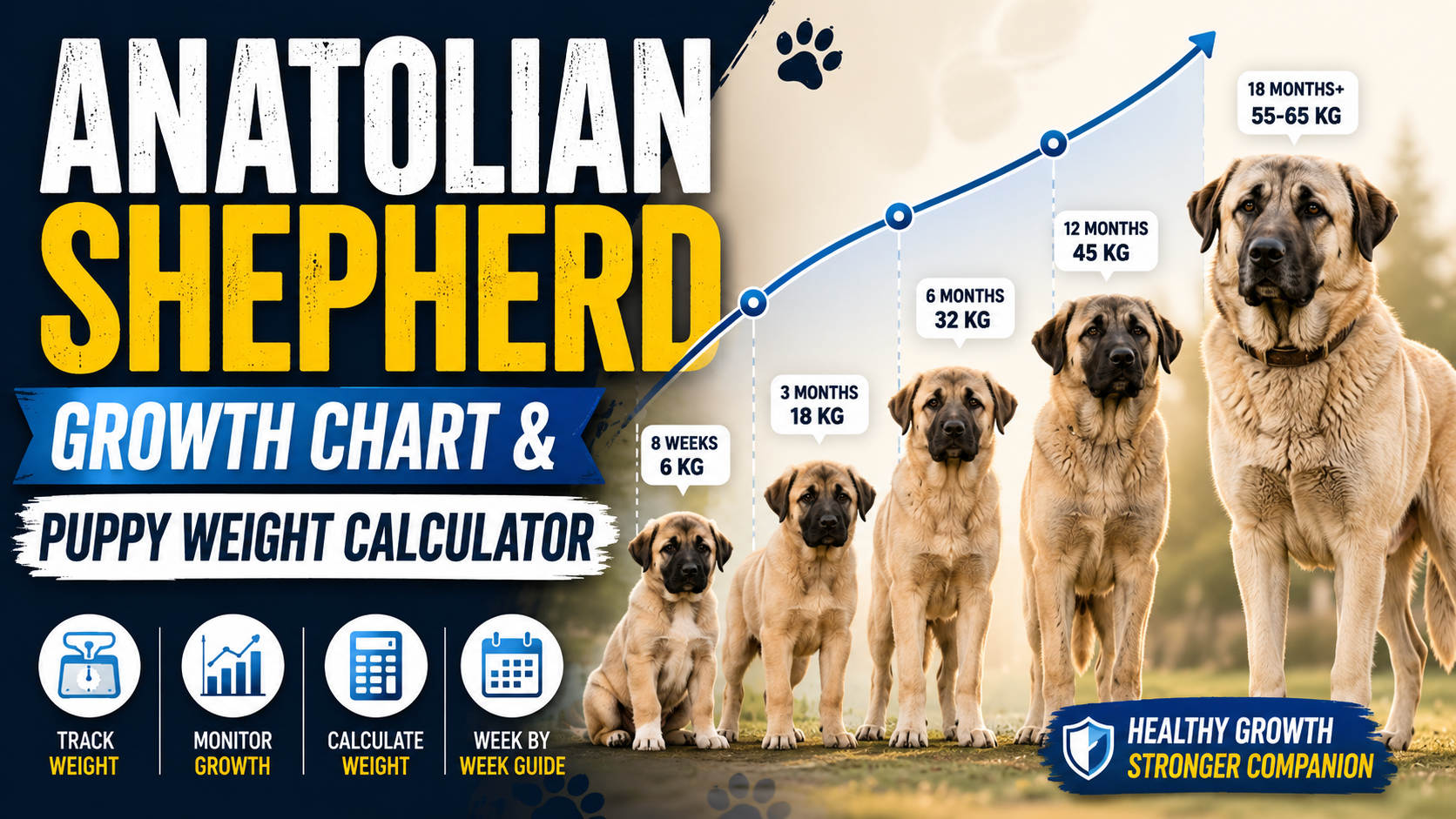
Anatolian Shepherd Growth Calculator Gender MaleFemale Unit Pounds (lbs)Kilograms (kg) Current Age (Weeks) Current Weight Calculate Adult Weight Estimated Adult Weight: Expert Note: Anatolian Shepherds are a slow-maturing giant breed. They reach their full height around 12-18 months, but will continue to add muscle and chest girth until they are 2.5 to 3 years old. Avoid overfeeding to force rapid growth, as this causes severe joint issues. Standard Growth Milestones Age Male (lbs) Female (lbs) 2 Months (8 wks) 25 – 35 lbs 20 – 30 lbs 4 Months (16 wks) 50 – 65 lbs 40 – 55 lbs 6 Months (24 wks) 70 – 90 lbs 60 – 80 lbs 8 Months (32 wks) 85 – 110 lbs 70 – 95 lbs 12 Months (52 wks) 100 – 130 lbs 80 – 105 lbs 24+ Months (Adult) 110 – 150 lbs 80 – 120 lbs Experiencing livestock guardian dynamics reveals that structural evolution defies simple linear expectations. By assessing an Anatolian Shepherd, owners witness profound biological transformations where early structural stability directly influences mature skeletal integrity and working capabilities. Many enthusiasts erroneously assume tracking mass is a straightforward endeavor. However, evaluating a growth chart requires an expert perspective, recognizing that dynamic development balances spatial awareness with raw substance across critical ancestral timelines. Anatolian Shepherd Growth Chart Managing a giant breed requires looking past the ballpark figure of standard breed averages. Tracking skeletal changes rather than daily mass increases provides an accurate projection of mature dimensions, especially during chaotic early developmental shifts. Evaluating the longer growth curve reveals structural landmarks that dictate future veterinary care costs. Utilizing breed-specific growth data prevents structural failure, ensuring structural integrity before choosing massive foundational equipment sizing like permanent structural kennels. Puppy Weight Calculator Predicting giant breed trajectories requires non-linear tracking rather than standard linear projections. Utilizing an automated puppy weight calculator allows owners to input a specific current age in weeks to baseline initial developmental trends accurately. By recording variables at this precise exact age in weeks, handlers bypass generic visual metrics. To ensure precision, you must weigh the animal during the morning, isolating true mass before feeding to maintain completely consistent results. Puppy Growth Stages Canine development challenges standard linearity, demanding expert physiological calibration. Early skeletal progress requires precise assessment. Puppies exhibit varying acceleration rates initially. Practitioners must carefully track these volatile initial milestones across a non-linear development timeline. Observing physical evolution directly confirms that individual genetics and structural baseline metrics dictate adult stature. Distinct dogs manifest structural diversity dynamically. Tracking mass variations during this foundational period ensures structural optimization throughout their lifecycle. How to Use the Growth Chart A meticulous veterinarian assessment highlights how assessing the growth chart mapping safeguards massive livestock guardians. Pinpoint your puppy companion’s current age metric first, rejecting generalized assumptions. Isolate their current weight against the expected range to gauge overall balance. Tracking metrics provides structural security, verifying that development continues safely without triggering excessive physical stress Factors That Affect Puppy Growth Altering foundational assumptions about ancient breed development reveals that independent structural maturation operates non-linearly. Our clinical observations indicate that livestock guardian dogs prioritize psychological stability before allocating metabolic resources toward expanding their large, powerful build. Centuries protecting Turkey from apex predators hardwired their physiology to delay mass accumulation. Consequently, a younger Anatolian Shepherd puppy frequently exhibits erratic sizing trajectories, defying standard linear projections through rapid skeletal spurts rather than consistent, uniform layering. About The Anatolian Shepherd Breed Working backwards from operational realities, an impressive size serves an ancient livestock protection mandate. This specialized breed channels innate loyalty into territorial dominance, treating its flock as an extension of structural safety. True independence manifests during the juvenile stage, when unique genetics dictate a longer adolescent timeline. Driven by specialized nutrition, these working dogs grow by individual milestones, demanding precision tracking across every phase. The Maturation Phase Observing this giant breed reveals how structural mass shifts randomly before stabilizing. An adult hound requires strict tracking to balance skeletal density, ensuring controlled growth patterns align with authentic breed standards. Musculoskeletal structures continue altering beyond typical timelines, complicating the growth trajectory. Veterans often monitor lateral muscle thickness rather than vertical height growth, validating why certain males expand until age 3. The Final Assessment As an experienced guardian of giant breeds, I monitor growth progress carefully to ensure healthy development. Unpredictable genetics and health status often complicate simple puppy weight calculators, meaning a mathematical formula rarely provides a 100% accurate or definitive medical assessments tool for your dog. Ultimately, evaluating your puppy using a body condition score (BCS) offers a better estimate of ideal body mass than strict breed size numbers. Partner with your veterinarian during regular vet checkup visits to adjust food portions dynamically.