
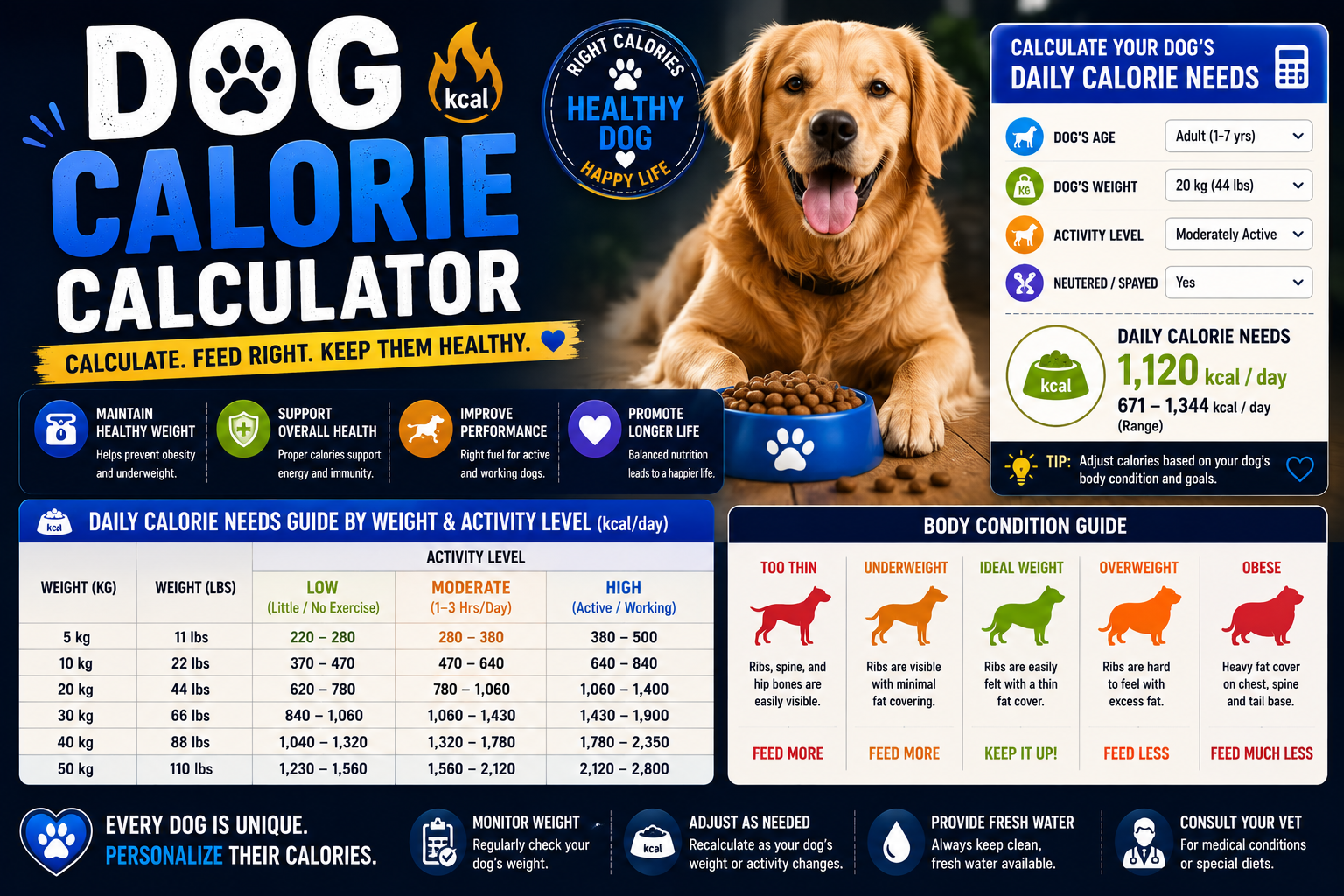
Keeping your furry friend healthy starts with what goes into their bowl, but guessing portion sizes can be a slippery slope. A Dog Calorie Calculator takes the guesswork out of mealtime by determining exactly how much energy your pup needs to thrive.
By factoring in crucial details like your dog’s age, weight, breed, and daily activity level, this tool calculates their precise daily caloric requirements. Whether you have a lazy couch potato or a high-energy pup, it ensures they get the perfect amount of fuel.
Using this calculator helps prevent common health issues like canine obesity or undernourishment, paving the way for a happier, longer life. It is the ultimate tool for pet parents who want to tailor their dog’s diet with scientific accuracy.
Table of Contents
Body Condition Score (BCS)
Practitioners often ignore the standard default protocols when evaluating canine physiques. Instead, they examine fat coverage directly to determine a dog’s health status. Evaluating the structural body shape helps us establish a proper nutritional baseline.
Clinical assessments shouldn’t rely solely on numeric figures like 5 or 6 without context. Every unique breed requires an individualized approach because physical builds vary significantly. We must carefully check physical attributes instead of assuming.
When users input details, an accurate resource becomes highly essential. Our clinical team utilizes a full visual BCS chart to guide owners. This prevents overfeeding dogs and ensures they maintain an absolute ideal BCS perfectly.
How Daily Calorie Needs Are Calculated (RER/MER)
Determining precise metabolic targets always involves analyzing foundational metrics. We look at the Resting Energy Requirement to establish a baseline before applying any physiological multiplier for activity. This ensures our formula aligns with energy expenditure.
When a pet exhibits an undesirable BCS 6–7, immediate dietary adjustments always become mandatory. Veterinary practitioners often implement a slow weight loss strategy. We must calculate the Maintenance Energy Requirement carefully to discover true targets.
To achieve an effective weight loss goal, tracking must always be absolute. Excessive Calories should be decreased gradually over weeks. This measured approach successfully supports canine vitality while shedding unhealthy pounds without risking metabolic shock.
Treats & Feeding Recommendations
In my clinical experience, reward items shouldn’t derail progress. Owners frequently overlook how easily small extras sabotage a diet. Ensuring that extra Treats never exceed the strict 10% caloric threshold keeps animals perfectly on track.
To achieve successful weight management, absolute consistency is always required. It is wise to Split the total daily food into smaller meals throughout the day. This simple scheduling adjustment promotes enhanced metabolic satiety for cats.
To avoid accidental canine overfeeding, throw away standard plastic cups. Utilizing a precise gram scale ensures your measurements remain completely accurate. This professional veterinary technique prevents the gradual weight gain triggered by dense kibble varieties.
Limitations of Calorie Calculators / Disclaimer
Relying strictly on an online calculator can easily mislead dedicated pet owners. These automated systems cannot mathematically pinpoint biological requirements because every animal is unique. We must evaluate the actual patient in front of us.
Metabolism isn’t a static calculation. Significant metabolic rate variation occurs regularly across distinct breeds, causing actual energy needs to vary from generic targets. Therefore, treating any digital outcome as a definitive baseline guideline is dangerous.
Collaborating closely with a qualified veterinary care team ensures clinical safety during weight reduction. Professional veterinary professionals fully understand how outside factors influence fat loss, creating a truly safe context that computer algorithms consistently ignore.
Compare Current Intake With Daily Feeding Needs
To initiate an effective feline dietary assessment, owners must first look at the entire daily total consumption. This includes measuring standard kibble and meticulously tracking snacks. Knowing exactly what goes into the bowl always matters.
Many well-meaning individuals regularly feed random table scraps without realizing the nutritional consequences. These high-fat additions quickly disrupt the internal metabolic balance. We must eliminate unmeasured items to establish a clean baseline for clinic evaluations.
When you finally compare current intake levels with real metabolic requirements, substantial discrepancies often appear. Our clinical goal is to narrow this gap systematically, ensuring proper energy distribution without causing any immediate biological physical stress.
What Should You Be Feeding?
Evaluating a dog’s lifestyle provides critical insight into their true energetic patterns. Working dogs require entirely different formulations than sedentary household companions. We must observe actual daily activity levels before designing any specific meal plan.
To determine accurate dietary volumes, first Estimate the baseline caloric requirements based on physical examination findings. This initial value serves as a clinical starting point rather than a permanent, unchangeable ruleset for daily feeding routines.
If real-world consumption stays consistently higher than measured metabolic expenditure, adipose tissue accumulation inevitably occurs. Practitioners must address these positive energy balances directly to prevent systemic inflammation from compromising long-term musculoskeletal canine patient physical health.
Use Calorie Estimates With Body Condition
Theoretical values work best when blended with tactile physical assessments. Relying solely on software numbers without examining the actual animal creates a disconnect. Practitioners must always lay hands on patients to gauge true physical condition.
When mathematical models are paired with physical touch, clinical accuracy increases dramatically. We examine fat distribution over ribs and waistlines to validate our initial calculations, ensuring the diet supports lean body mass completely and effectively.
Implementing systematic body condition checks allows practitioners to track physical progress accurately. These regular hands-on evaluations confirm whether our calorie adjustments are working or if the patient requires further metabolic protocol updates to succeed completely.
Senior Status by Breed Size
Aging looks entirely different depending on skeletal size. For instance, Large/giant breeds experience rapid cellular aging much faster than smaller counterparts. Their nutritional transition protocols must begin much earlier to protect canine joint health effectively.
When an animal reaches its later years, metabolic efficiency declines significantly. We must adjust caloric densities downward to prevent corporate obesity, ensuring senior pets maintain an active, comfortable lifespan without experiencing unnecessary metabolic joint strain.
Defining a pet’s senior status requires looking beyond chronological age alone. We evaluate organ functionality and joint mobility to determine exactly when an individual patient truly transitions into their senior life stage completely and safely.
From Veterinary Manual
Consulting official literature provides foundational guidance for complex nutritional cases. This independent article content offers deeply researched frameworks that challenge traditional commercial feeding methodologies, allowing us to think beyond standard retail pet dietary advice completely.
When seeking specific peer-reviewed data, navigating to a related topic page can reveal hidden metabolic insights. These authoritative academic write-ups provide the physiological context that basic consumer software simply cannot reproduce or simulate accurate results.
Clinical proficiency requires studying the official Nutritional Requirements of Small Animals text. This comprehensive guide details macro-nutritional distributions that help practitioners formulate specialized diets for animals experiencing complex physiological metabolic health disorders very effectively today.
Final Thoughts
A dog calorie calculator is an excellent tool for keeping your furry friend fit, lean, and healthy. It provides a clear baseline for their daily energy needs based on their weight, helping you prevent overfeeding and the serious health risks associated with canine obesity.
However, it is important to remember that these calculated numbers are just a starting guideline rather than a strict rule. Every dog has a unique metabolism, age, and daily activity level, meaning you may need to subtly adjust their portions to perfectly match their individual lifestyle.
For the best results, always consult your veterinarian to customize a precise nutrition plan for your pet. Keeping a close eye on their physical condition and adapting their food intake accordingly is the ultimate key to ensuring they live a long, happy, and active life.
What is a Dog Calorie Calculator and why is it important?
It is a digital tool that estimates your dog’s daily calorie needs based on factors like weight, age, and activity level. Using it helps you avoid overfeeding or underfeeding, ensuring your pet maintains a perfectly healthy and balanced weight.
What key factors should be considered when calculating calories?
You need to input your dog’s current weight, age, and lifestyle—whether they are a lazy couch potato or a highly active runner. Additionally, whether your dog is spayed or neutered matters, as altered pets generally require fewer calories.
Do all dog breeds follow the same calorie formula?
You should recalculate whenever your dog goes through a major life stage change (like moving from puppy to adult), experiences a shift in weight, or alters their activity routine. As a rule of thumb, checking it twice a year is ideal.
What should I do if my dog still gains weight after using the calculator?
Calculators provide a baseline estimation, but every individual dog’s metabolism varies slightly. If your dog is gaining weight, try cutting back on extra treats, reducing their daily food portion by about 10%, or consulting your vet.
How often should I recalculate my dog’s daily calorie requirements?
You should recalculate whenever your dog goes through a major life stage change (like moving from puppy to adult), experiences a shift in weight, or alters their activity routine. As a rule of thumb, checking it twice a year is ideal.
Related Articles:
Chihuahua Age Chart Calculator
Standard Schnauzer Puppy Growth Chart & Weight Calculator
Standard Poodle Growth Chart & Weight Calculator